


Sitting at a table alone, not three yards from Tamryn, was Halverson Ramsay Ford.
It was strange to see him without a crowd of hangers-on. He gazed out, smiling loftily, giving Tamryn an opportunity to size him up, one part at a time.
The parts were well worth looking at. Long lean legs, stretched out in an attitude of power at rest. Deeply tanned, well-muscled arms. Golden-brown hair with sunlit flaxen glints, cut in a short cap reminiscent of Roman emperors. With his noble profile and strong build, he might’ve been the model for an Early Imperial statue.
His facial features were irregular. Smallish eyes with feathery, almost delicate arches of eyebrows. A biggish nose. A wide mouth. A long, squared-off chin.
But put them together, and it worked. Whatever else might be true of him, Halverson Ramsay Ford was objectively stunning.
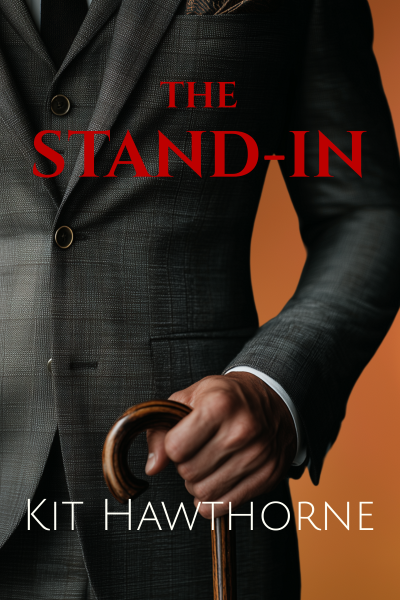
He was overdressed for the pool, in linen trousers and a madras shirt with the sleeves rolled up, the edge hitting just below the widest part of his biceps. In one hand he held a half-empty glass of amber liquid; in the other, a brass-headed cane.
Why wasn’t he in the water, showing off those guns, that chest? Twelve years ago, he’d have been the center of attention, carrying some hot girl on his shoulders. Maybe his game leg wouldn’t hold up to such shenanigans now, but he could still stand in the shallow end with the water lapping his rock-hard abs. It was one thing for Tamryn to sit with a book, hiding her body beneath a coverup. It was something else for HRF to be anywhere but in the thick of the action.
Suddenly he was looking at her—not a fleeting or accidental glance, but a bold, deliberate stare.
Heat flooded her cheeks as a thousand humiliating memories washed over her. She dropped her gaze to her book, letting her hair cover her face, an old high school habit. The letters dancing before her eyes might as well have been Akkadian cuneiform for all the meaning they imparted.
Oh no. Surely those weren’t footsteps coming her way.
She kept her head down, willing herself to disappear. Step tap, step tap. The sound of a man walking with a cane.
A shadow darkened her page, and a rich, mellow voice read aloud, “It is told that in their beginning the Dwarves were made by Aulë in the darkness of Middle-earth.”
Tamryn’s spine stiffened. She hated it when people read over her shoulder. The tone of his voice wasn’t snide—it had the perfect dramatic heft—but that was somehow worse. HRF was a master of straight-faced mockery, luring people in with his charm before springing his trap.
A large, elegant, masculine hand set a glass on the table. Then HRF came fully into view and began maneuvering himself into the next chair.
With the backs of his legs touching the seat, he slid his left leg forward while tilting his cane away from his side, then gripped the armrests and lowered himself gently to the seat, his good leg bearing most of his weight on the way down.
Tamryn watched, holding her breath for the critical moment just before that perfect backside made a successful touchdown.
HRF hooked the cane’s handle onto the armrest and leaned back with a sigh. Then he picked up his glass and looked at Tamryn with eyes of pale, clear, Jadeite green.
“You’re reading The Silmarillion.”
A pale scar slashed through his right eyebrow, memento of high school basketball. He’d taken an elbow to the head but refused to come out of the game, so the cut had been patched with Steri-Strips and skin glue. With his money, he could’ve had the scar fixed, but he hadn’t. Tamryn remembered reading that scars, within reason, made men more attractive and women less so. It wasn’t fair. Nothing was fair.
He waited. Tamryn’s mind raced as she tried to formulate a reply polite enough not to disgrace her ancestors, but distant enough not to invite conversation.
“Yes,” she said.
“At a pool party,” said HRF. His tone held no reproach; it was perfectly neutral.
“Yes,” Tamryn said again.
He held her gaze, his expression blank. Tamryn’s stomach tightened, but she didn’t break eye contact.
One corner of the wide mouth edged up, and HRF raised his glass to her. “I like it. It’s a rebel move, refusing to conform to social convention. It sends a message.”
“What message is that?”
“That you might not have been able to stop this party from happening, but you don’t have to participate.”
Tamryn stole another glance at her mother, who was now adjusting the angle on the McGraws’ table umbrella. She’d worked hard to make this party a success, and all she’d required of Tamryn was to be civil to the guests—not an unreasonable request to make of a college-educated daughter who’d been living rent-free in her parents’ house for three months, having her meals brought up on trays. It was basic human decency—not to mention heredity. Tamryn was descended from a long line of Virginia gentry on one side and Minamoto samurai on the other, and she was letting them all down.
What was HRF’s endgame? What punchline was he setting up? She could do her best to second- and third-guess him, and herself, but he was too quick on his feet for her. In the end, he’d win, and make her look like a fool.
She shut the book with a thud and laid it on the table. “Will you do me a favor?”
The feathery eyebrows lifted. “Anything you ask, up to half my kingdom. What is your request, my lady?”
“That you skip the setup and go straight to the point. I’ve never been good at repartee, and I don’t have the skill or energy to cross blades with you. So whatever insult you’re working your way up to, go ahead and make it. I forfeit the match.”
Her heart pounded, and a flood of wild power coursed through her. This must be what adrenaline junkies felt like when they bungee-jumped off cliffs.
The jade-green eyes stayed fixed on her. “You think I came over here to insult you? You think this whole conversation has been a setup?”
She shrugged. “Maybe you don’t plot it out in advance. Maybe you go with the inspiration of the moment. But however it happens, you always manage to make yourself look clever and the other person look like an idiot.”
She shouldn’t have said always. She’d put herself in a false position. HRF didn’t call her on it. He just tilted his head and waited.
“I mean, not always always,” she amended. “Not if the person is a toady of yours, or a woman you’re flirting with, which in this case…”
She broke off. HRF looked truly perplexed, with the middle of his forehead pushed into attractive furrows.
“First of all,” he said, holding up an elegant index finger, “thank you for saying toady. I don’t think I’ve ever come across that word outside of books. Secondly—” another finger unfurled alongside the first “—what do you mean, in this case? Why is it so out of the question that I could be flirting with you rather than contriving some elaborate verbal takedown?”
“I have one word for you,” she said. “Garanimals.”
To her shame, her throat swelled up, and her eyes stung with tears. She dug her nails into her palms, willing herself not to cry.
“I don’t expect you to understand,” she said, staring at the cabana’s roof. “No one who’s been beautiful all his life can have any idea what it’s like to look in the mirror and—”
She couldn’t finish. She waited for HRF to laugh, or start riffing on the fact that she’d called him beautiful. But he didn’t speak. The silence stretched out, longer and longer, until she looked at him again.
Something had happened to his face. If it had been anyone else’s face, she’d have said he looked embarrassed. And when he spoke, his voice had lost the gloss of charm.
“I don’t have to tell you that I’ve been a colossal jerk for most of my life. I’ve said and done a lot of reckless and hurtful things. I won’t ask you to forgive me, because I have no right—but I will say that I was wrong, and that I’m sorry. And for the record, Tamryn, you’re a lovely woman, and I think I would enjoy flirting with you, if flirting was your style.”
She waited for the other shoe to drop, for a flicker of a smirk to give the lie to his words. But those clear green eyes looked right back into hers.
Finally she muttered, “Let’s just drop it.”
The remorse cleared from his face. “Good. Because I want to talk about The Silmarillion.”
This was so unexpected that it startled a laugh out of her. “Why?”
“Because it’s a brilliant and beautiful work, that’s why.”
“You’ve read The Silmarillion,” she said.
She didn’t believe it. Actually reading The Silmarillion was a rare feat even among professed Tolkien aficionados. Maybe he’d watched that Rings of Power show on Prime, or a YouTube video with a name like “The Silmarillion in Three Minutes”—something to file away in that legendary memory of his and pull out when needed as a party trick.
Well, he’d chosen the wrong subject to pretend to be knowledgeable about.
But before she could come up with an arcane question to put him in his place, HRF said, “That chapter you’re on is a favorite of mine. I know it’s presumptuous to speak of favorite chapters in such a masterpiece, but I relate to Aulë, because he’s a craftsman who loves the things he makes. And I know it’s vain of me to identify with one of the Lords of Valinor who took part in the creation-song of Ilúvatar before the dawn of Time—but I do. Aulë is the kind of guy who looks at the world and sees it not just as it is, but as it could be. He has a vision, and he’s willing and able to do what it takes to make that vision a reality.”
“So did Melkor, when he brought evil into the world,” Tamryn said.
“That was different. Melkor wanted power and glory. Aulë wanted some sentient beings who could rejoice in the world Ilúvatar had created, and use and appreciate the things Aulë made. That’s why he fashioned the Dwarves—for company.”
“Yeah, acting in secret. He knew he was doing wrong.”
HRF tilted his head back and forth in a considering-both-sides gesture. “Out of bounds, yes, but morally wrong? I have to disagree. Remember that conversation between him and Ilúvatar, when Ilúvatar asks him why he made the Dwarves, and whether he wants them to be his puppets? Aulë says no, he only wanted things other than himself, to love and teach. But he admits he was foolish and impatient, and says he’ll destroy the Dwarves if that’s what Ilúvatar wants. So he raises his hammer…”
“And the Dwarves cry out, and shrink away,” Tamryn said. “And Ilúvatar says, look, they do have life in themselves. And he lets the Dwarves live. But they can’t come forth ahead of the Elves, so he puts them to sleep, underground.”
“And he says there’ll be strife between the Dwarves and the Children of Ilúvatar,” said HRF, “and between the Dwarves and the trees, because Aulë hid his work from his consort, Yavanna, who cares for all the things that grow in and on the earth.” He pronounced Yavanna correctly, elongating the double-N. “But the Dwarves will have a special place in Middle-earth—and in the End, after the Final Battle, their part will be to help Aulë in the remaking of the world.”
Unbelievably, his own eyes shone with tears.
What was happening? Had Tamryn been sucked into an alternate dimension? The HRF she knew didn’t care about literature. He’d built his first computer at age ten, a functioning robot at twelve. By sixteen, he was making contributions to an open-source platform for biomedical research. He’d scoffed at the so-called soft sciences to a degree that made Neil deGrasse Tyson look like a patron of the arts.
She wouldn’t put it past him to do a thorough study of Tolkien’s entire body of work, to get points with someone he wanted to impress. But how could he predict that Tamryn would be reading The Silmarillion today? And what possible motive could he have to impress her?
Suddenly she had the sensation of standing outside herself, dispassionately examining her own thoughts—her mean, suspicious, paranoid thoughts.
What if HRF’s knowledge of The Silmarillion had nothing to do with elaborate tricks or multiverse collisions? What if he’d simply read and enjoyed the book and was making conversation at a party?
Maybe, just maybe, Tamryn was neither the butt of a potential joke, nor the object of an unlikely seduction, but only someone he was talking to. Maybe it was possible even for a jerk like HRF to grow up—and maybe Tamryn could see that if she hadn’t been so warped by what had happened to her. The Unspeakable One had mutilated her soul, turning her into a caricature of herself.
HRF stared into the middle distance, presumably thinking Tolkienesque thoughts.
“I don’t remember you being much of a humanities guy,” Tamryn said.
He gave her that crooked smile. “It’s a recent development. I was laid up a long time after the accident, and I read a lot.”
Tamryn thought of her own late-night reading, how it had become a lifeline, saving her from lying in the dark and remembering.
“Besides,” said HRF, “it’s a mistake to think in a strict dichotomy of STEM versus humanities, as if they’re opposites or adversaries. That whole duality is a modern notion. Nowadays people are so proud of being hyper-focused on one area and completely incompetent in everything else, like it’s a mark of genius. It’s ridiculous—but it’s changing, I think. Some medical degree programs are integrating more humanities into their curricula. I read about a study where medical students were trained to make detailed drawings of anatomical structures from memory. They outperformed the control group at making certain kinds of diagnoses. The act of drawing gave them a better understanding of the spatial relationships between—”
“Why aren’t you in the pool?” Tamryn asked.
She was being rude, but the whole scenario seemed to have turned into the sort of crazy dream where you just give in to the weirdness and see where things go.
HRF took the interruption in stride. Twirling his cane, he said, “I have a lot of scarring from the accident—burns and abrasions, surgical incisions. The wound got infected with some nasty antibiotic-resistant bacteria, and the necrotic tissue had to be removed. It’s healed now, but kind of a mess.”
“Oh. I didn’t know that.”
He shrugged. “I’ve got a lot to be thankful for. For a while it was touch and go whether I’d survive, let alone walk again. But here I am. And as long as I’m covered up, it’s fine. A bit of a limp and an antique cane, that’s peak villain energy. Sans trousers, not so cool.”
“Is the scarring confined to your lower body?”
“Pretty much.”
“Then why not discreetly strip down to your trunks and slip into the shallow end? I mean, look at you. You’re ripped. You might not be able to romp around, but you could stand there with your mint julep, looking handsome and suave. The ladies would flock around.”
HRF chuckled and held up his drink. “It’s iced tea. Yeah, maybe I could push past the mental discomfort and do all that. But I’ve done a lot of fighting this past year—fighting for my life, fighting for my company, fighting to walk again. Sometimes I get tired of fighting.”
Tamryn remembered coming out of that conference room at the end of a successful legal settlement, the culmination of months of hard decisions and stress, and collapsing in a dead faint, like a Southern woman in an antebellum novel. She remembered the physical fatigue of the early weeks of her illness, mixed with mental and emotional exhaustion.
“Fair enough. So what else did you read while you were laid up?”
“A lot of epic poetry. Beowulf, the Iliad. Gilgamesh. Fingal and Temora—”
“Fingal and Temora? The Ossian poems?”
HRF grinned. “Haha! I thought that’d get a rise out of you. Yes, I read the complete works of Ossian, the blind bard of the Scottish Highlands.”
“But there was no such person! Ossian was a made-up character that James Macpherson used as the purported narrator of his own poetry. The whole thing was an enormous hoax!”
HRF tilted his head, considering. “Admittedly Macpherson may have bent the truth. But how is that different from Tolkien’s claim that The Lord of the Rings was his own translation of the Red Book of Westmarch, a contemporaneous account of the War of the Ring written by Bilbo and Frodo Baggins and Samwise Gamgee?”
“It’s completely different! That wasn’t a serious claim—it was a literary device!”
“Maybe Macpherson’s claim was a literary device too.”
“No, it wasn’t! Macpherson claimed to have worked from actual ancient Gaelic manuscripts, which he was always promising to produce but never did. He wasn’t that great a Gaelic scholar anyway, so even if the manuscripts had existed, he’d hardly have been qualified to translate them.”
HRF’s grin widened. The more she disagreed with him, the happier he looked. “Regardless of who wrote the Ossian poetry, or when, you can’t deny that it was a stupendous literary achievement, which inspired the Celtic Revival and, arguably, the entire European Romantic movement. If not for Ossian—or Macpherson—Sir Walter Scott would never have written your beloved Marmion. So there.”
“How do you know I love Marmion?”
“I was there when you were introduced to it. Remember that party my parents gave, sophomore year? You cast one look at all the callow youths in attendance, shimmered off to the library, found a volume of Scott’s poetry, and curled up with it in my father’s leather chair. You spent most of the party reading it.”
She stared.
“You remember, don’t you?” he asked.
“Yes. I’m just surprised that you do.”
“I remember everything.”
She was beginning to believe it. He’d always been famous for the effortless recall that enabled him to ace exams with minimal studying, but she wouldn’t have thought he’d bother keeping track of anything related to her. Several of their more popular classmates had been at that party, and his cousins. She doubted whether the two of them had interacted at all.
“Your father gave me that book,” she said.
“I know. And you wrote him a nice little thank-you letter. I found it in his desk after he died. He liked you. Said you had a mind like a deep well.”
“That was gracious of him,” Tamryn said. “I was pretty cheeky, helping myself to a first edition Scott off someone else’s bookcase. I didn’t realize at the time how valuable it was. I still have it. Your parents had a magnificent library.”
“A fine compliment coming from you. Your degree is in library science, right?”
“My master’s and doctorate are. My bachelor’s was in English.”
“Good combination. You did your post-graduate work at…William & Mary?”
“No, UT Knoxville. William & Mary was where I did my practicum. They offered me a job, so I worked there after finishing my degree.”
“Worked? Past tense?”
“It was before I got sick.” And before the worst emotional and financial upheaval of her life, but a months-long debilitating illness was excuse enough. It was convenient how the drama with The Unspeakable One had transitioned seamlessly into mononucleosis.
“Did you resign?”
“I took a leave of absence. I could go back if I wanted.”
“But?”
She thought of her ex-fiancé. He’d left the university, but the place was tainted by him.
“But I don’t want to,” she said.
“Then maybe you should do something else. Put that deep well of a mind to good use. Might be a great opportunity. A lot of times people get stuck in a rut. They daydream about living a different life, but don’t see how to make it happen. Maybe this is your chance to break free and try something new. Are there any dreams you’ve let slide because you had a job and bills and habits tying you down?”
Before she could answer, his phone went off. He fished it out of his pocket and tapped the red circle.
“Sorry. Anyway, I hope I’m not speaking out of turn, but I do have some experience here. Having your world blown up can be good for you. It forces you to take stock, to find out what you’re made of, and whether you truly believe the things you say you believe. Not that I’d willingly endure any of it again.”
“Yeah,” said Tamryn. “Sometimes you go through something that changes the world forever. You survived, but things will never be the same.”
“Like the Fall of Númenor,” said HRF. “The Isle of Meneltarma is set out of reach, and however far you sail you only end up where you started, because all roads are now bent.”
“Yes,” said Tamryn, and again her eyes stung with tears.
“Though they say,” HRF went on, “that there yet remains a Straight Road, for those permitted to find it. The path of the memory of the West, like an invisible bridge leading to the Undying Lands, as the bent world drops away beneath it.”
Silence. Then HRF said dreamily, “That last bit always makes me think of non-Euclidean sphere geometry.”
Tamryn laughed, surprised out of her tears. “I honestly never connected those two things—but, yeah, I see what you mean. Did you know that Lewis Carroll passionately hated non-Euclidean sphere geometry? All that stuff in Alice’s Adventures in Wonderland with distorted rooms, and weird curvatures, and Alice changing size and shape—that’s what that’s about.”
She wouldn’t have thought he could look any more delighted, but he did. “Are you serious?”
“I’m always serious,” said Tamryn.
His phone went off again. He frowned at it. This time Tamryn saw the screen. Someone called The Man was attempting to FaceTime.
“Do you need to take that?” she asked.
“No, it’s just work,” he said, rejecting the call.
“So who qualifies as The Man to Halverson Ramsay Ford?”
He laughed ruefully. “You might just be surprised.” Then he asked, “Would you do me a favor?”
She’d posed the same question to him minutes earlier. He’d rashly agreed to do whatever she wanted, but she was not one to leap before she looked.
“What is it?”
He leaned close. “Could you possibly find it in your heart to call me Hal?”
“Hal,” she said. “Like the evil computer in 2001: A Space Odyssey?”
“More like Prince Hal in Shakespeare’s King Henry IV. A man ready to leave his misspent youth behind and take his rightful place as a leader.”
“But Prince Hal’s misspent youth was a ruse to make his enemies underestimate him. What’s your ruse?”
His phone went off a third time. He picked it up, rejected the call, and stared glumly at the screen. “I’d better call him back.”
Tamryn was strangely disappointed. “If it’s secret medical tech stuff, you can take it in the guest house.”
“Thanks.”
He laid the phone down and began the process of standing. Cane gripped in fingers. Heels of hands braced on armrests. Backside at edge of chair. Foot of weaker leg forward. Bear down on armrests while pushing self up with strong leg. A moment to steady self, then—
“See you later, Tamryn,” said Hal.
He pocketed his phone and walked away. Step tap, step tap.
Tamryn opened her book. She tried to lose herself in the printed word and be transported to the world of imagination where she’d taken comfort for so long, but something had changed. She felt restless, like at the end of a long illness where you’re not quite strong enough to be up and about but don’t want to stay in bed anymore. She kept glancing at the corner of the guest house where the tall, jaunty, limping figure had disappeared, hoping and dreading to see it return.
Return to The Stand-InPre-Order




- Booktopia